In Dubai, digital adoption is ongoing as organisations evolve to integrate digital systems as a core part of their financial, logistical, customer and reporting processes, and enterprise planning. When organisations grow, spread out systems and processes can cause delays, lack of transparency, double handling and inefficiencies. Due to these challenges, ERP systems are now becoming more and more a key pillar for business expansion and sustainable scalability.
ERP systems have expanded to more than just accounting capabilities. Today’s ERP systems feature finance, procurement, supply chain management, inventory, customer service, workforce management, analytics, and reporting, all within a unified system to enhance organizational control. ERP implementation partners are becoming vital in the process of successful ERP implementation, integration, optimisation and operational support in businesses that need fast decisions and flexibility.
Organizations turn to specialists, such as WaveRiser IT, when modernizing systems becomes essential. Rather than delay upgrades, many adopt structured approaches to digital evolution. Infrastructure adjustments follow, guided by long-term operational needs. Enterprise applications connect smoothly, due to careful planning. Cloud platforms enter the workflow, enhancing accessibility across departments. Security models form early in the process, reducing exposure over time.
Automated functions emerge, designed around efficiency and environmental impact. ERP deployment support now ranks high among strategic initiatives. Internal procedures simplify once integration reaches completion. Performance remains stable throughout transitions, preserving daily output. Enterprise ERP Solutions continue shaping how Dubain businesses approach operational growth.
Why ERP Systems Are Becoming More Important in 2026

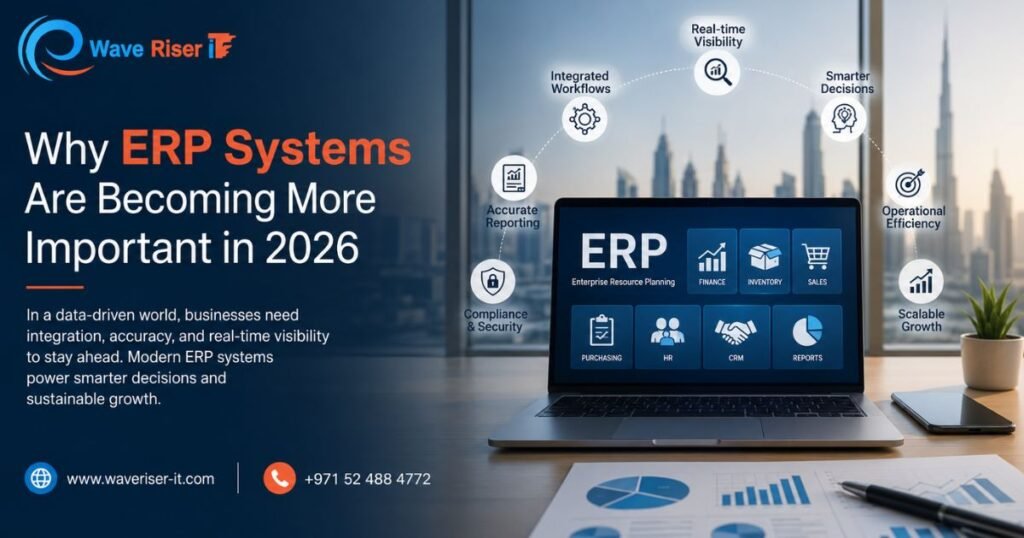
In today’s data-rich world, businesses in Dubai are working in a big data context. To be able to make decisions, it is crucial to report accurately, have integrated workflows, have real-time financial visibility, and have operational coordination between departments. Legacy systems are hard to manage when information is split between various systems and becomes more complex with increased operational activities.
Modern ERP solutions provide businesses with the following advantages:
- Centralise operational data
- Improve reporting accuracy
- Simplify finances and accounting procedures
- Enhance inventory management
- Automate procurement processes
- Improve workforce coordination
- Support regulatory compliance
- Strengthen customer management
Rather than isolated software ecosystems, businesses are turning to a single environment where data seamlessly moves between business functions.
Still gaining ground, Microsoft Dynamics 365 Business Central shows steady movement. Notable shifts emerge as usage expands across departments. With each update, adaptation follows in quiet but measurable steps. Progress appears without fanfare, yet momentum builds beneath routine operations. Change unfolds gradually, marked by consistent integration rather than sudden leaps.
Among widely used ERP platforms across Dubai, Microsoft Dynamics 365 Business Central stands out clearly for medium enterprises needing room to grow alongside smooth system connections. Because it links effortlessly with existing Microsoft tools, operates efficiently in online environments, delivers detailed reports, meets regional regulations like GST and wage processing – this solution draws consistent interest from local firms. Despite varying needs, its balance of function and adaptability remains notable.
A few identified benefits are:
- Integration with Microsoft 365
- Cloud-first infrastructure
- Scalable financial management
- Every type of inventory and warehouse software
- Business intelligence integration
- Workflow automation
- Multi-location support
ERP adoption is no longer just a software upgrade; it’s a strategic investment as businesses move towards a more connected accounting environment.
Cloud ERP Continues its Transformation of Business Operations
Cloud ERP has become the main topic in ERP discussions throughout Dubai. On-premises solutions can have higher infrastructure costs, hardware management needs, manual update requirements and maintenance needs. Cloud ERP systems offer improved flexibility and a range of remote access, automatic updates, scalability and simplicity of infrastructure.
A number of ERP vendors are still developing cloud-based functionalities such as:
- Oracle NetSuite
- SAP Business One
- MYOB Acumatica
- TechnologyOne
- Epicor Kinetic
- Odoo
- SYSPRO
The power businesses in a variety of sectors such as manufacturing, logistics, retail, finance, mining, education and professional services.
Cloud ERP also creates a seamless cross-department real-time view of operations, which decreases delays and enhances the agility of the business.
ERP Implementation Partners Play A Critical Role
Implementation partners matter greatly when putting an ERP system into practice. Their involvement shapes how smoothly the process unfolds. One without support may face delays or missteps. Success often depends on their experience level. Guidance from these individuals helps maintain direction. Without them, progress could stall unexpectedly. Clarity in tasks comes through their presence. Each step forward links closely to their input.
Success in transformation goes beyond just selecting an ERP system.
The complexity of deployment, the configuration of the workflow, planning for integration, migration strategy, security measures, employee adoption, and ongoing support after deployment all play a significant role in determining long-term success.
Implementing ERP is a process that requires support from ERP implementation partners, who can help businesses with the following:
- Planning and consulting for the system
- Business process analysis
- Cloud migration
- Software customisation
- Integration management
- Security and compliance
- Data migration
- User training
- Ongoing technical support
In Dubai, more attention is being given to implementing strategies that focus on the industry to minimize disruption during digital transformation initiatives.
Knowledge of implementing systems becomes particularly crucial when organisations grow in size and need to ensure smooth operations throughout migration.
How AI, Automation, And Analytics Are Impacting Today's ERP Systems
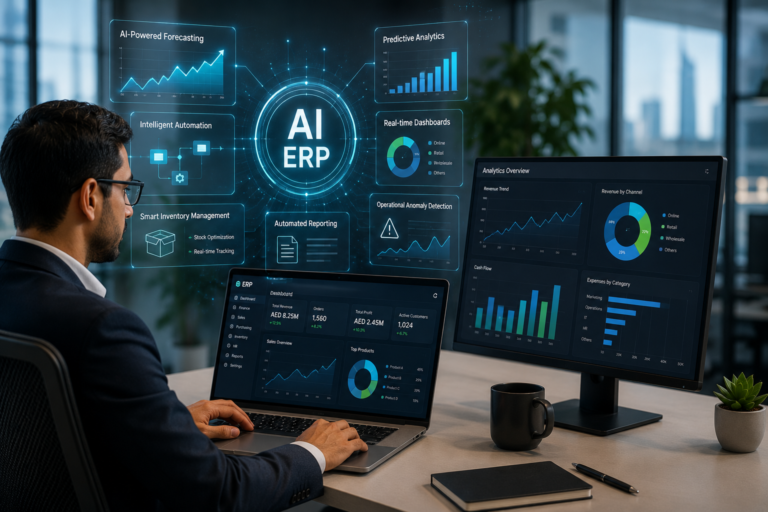
In 2026, ERP platforms will be even more embedded in enterprise workflows with built-in AI capabilities and features of automation, predictive analytics, and business intelligence. Contemporary systems do more than hold information—they also contribute to the optimization of operations and quicker decision-making.
New ERP capabilities are beginning to emerge in the following areas:
- AI-powered forecasting
- Predictive analytics
- Intelligent workflow automation
- Automated reporting
- Real-time dashboards
- AI-enhanced customer insights
- Smart inventory management
- Operational anomaly detection
When businesses move toward updated ERP setups, reliance on reactive reporting alone becomes less acceptable. Instead, anticipation of operational needs begins to take priority. Systems able to support forward-looking management gain interest. A focus emerges not solely on what happened, but on what might come next. This change reflects a broader expectation: tools should guide decisions before issues arise. Awareness grows that insight after the fact is no longer enough.
Security, Scalability, And Long-Term Support Remain Essential
Long-term support matters just as much as scalability – security remains a steady priority. Vital concerns shift slowly, yet each element holds weight equally over time. Scalability ties closely to endurance, while protection stays non-negotiable throughout.
With increasing agility and inter-connectivity of enterprise systems, cyber security and governance needs also keep growing in tandem with complexity of operations. ERP systems may be integrated with accounting data, CRM information, inventory and logistics details, HR payroll, and operational analytics, all of which can be very sensitive.
With such ERP infrastructure, it is heavily reliant on:
- Secure cloud architecture
- Access management controls
- Compliance frameworks
- Backup and disaster recovery
- Continuous monitoring
- High availability infrastructure
- Scalable deployment planning
Technology vendors, such as WaveRiser IT, are assisting businesses to build enterprise environments that are more resilient, with cloud infrastructure planning, enterprise app support, intelligent automation and cyber security implementation, and scalable IT transformation strategies that enhance long-term operational resilience.
The Future of ERP In Dubai Continues Evolving
ERP uptake across Dubai advances steadily, pushed forward through demands for clearer operational insight alongside stronger digital frameworks. With momentum building, systems evolve to meet modern requirements – cloud integration shapes progress here. Automation gains traction because efficiency becomes essential within complex environments. Enterprise management shifts as intelligent analysis begins influencing daily decisions. Integrated processes stand central now where once they were optional extras nearby. Businesses seeking ERP implementation solutions in Dubai increasingly prioritise scalable systems capable of supporting long-term operational growth.
ERP platforms are no longer limited to a back-office function but are now expected to act as the central operational engines to aid decision making, improve efficiency, ensure scalability and growth. With the digital transformation landscape still in a constant state of change, proven implementation partners are critical for organisations to help them manage more complex enterprise technology environments.